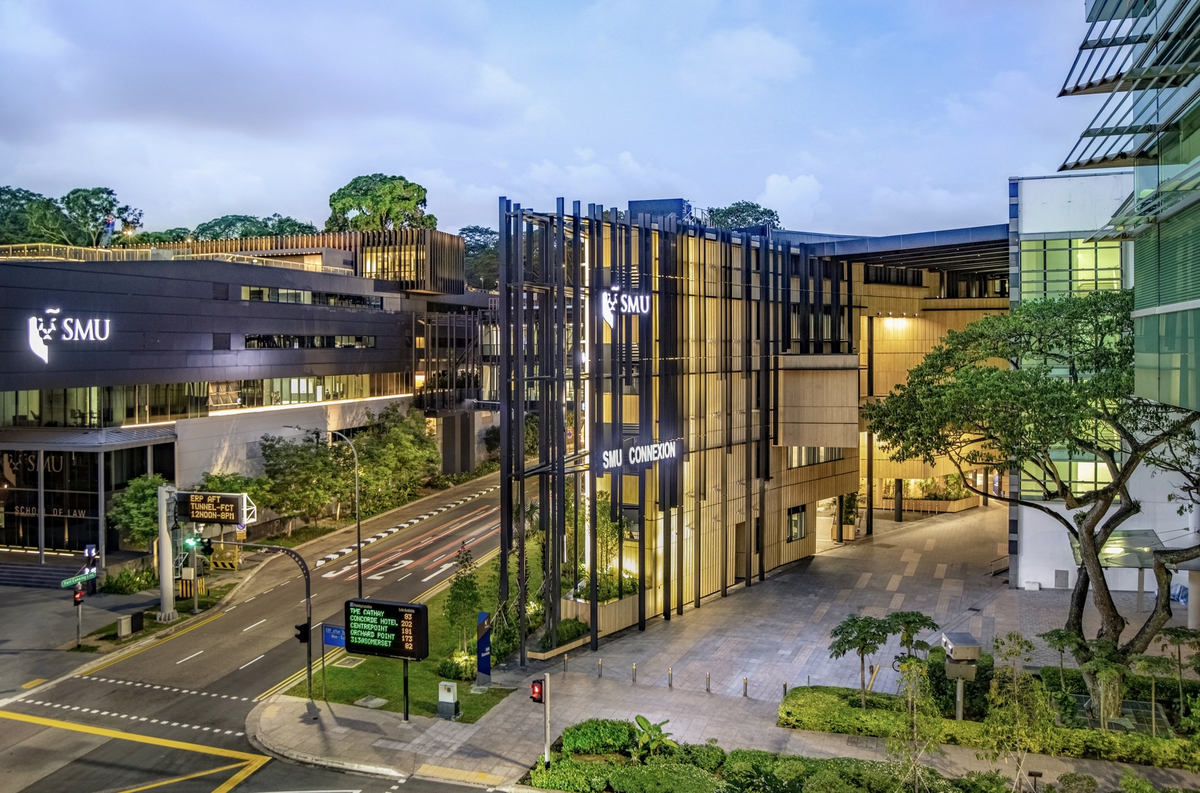
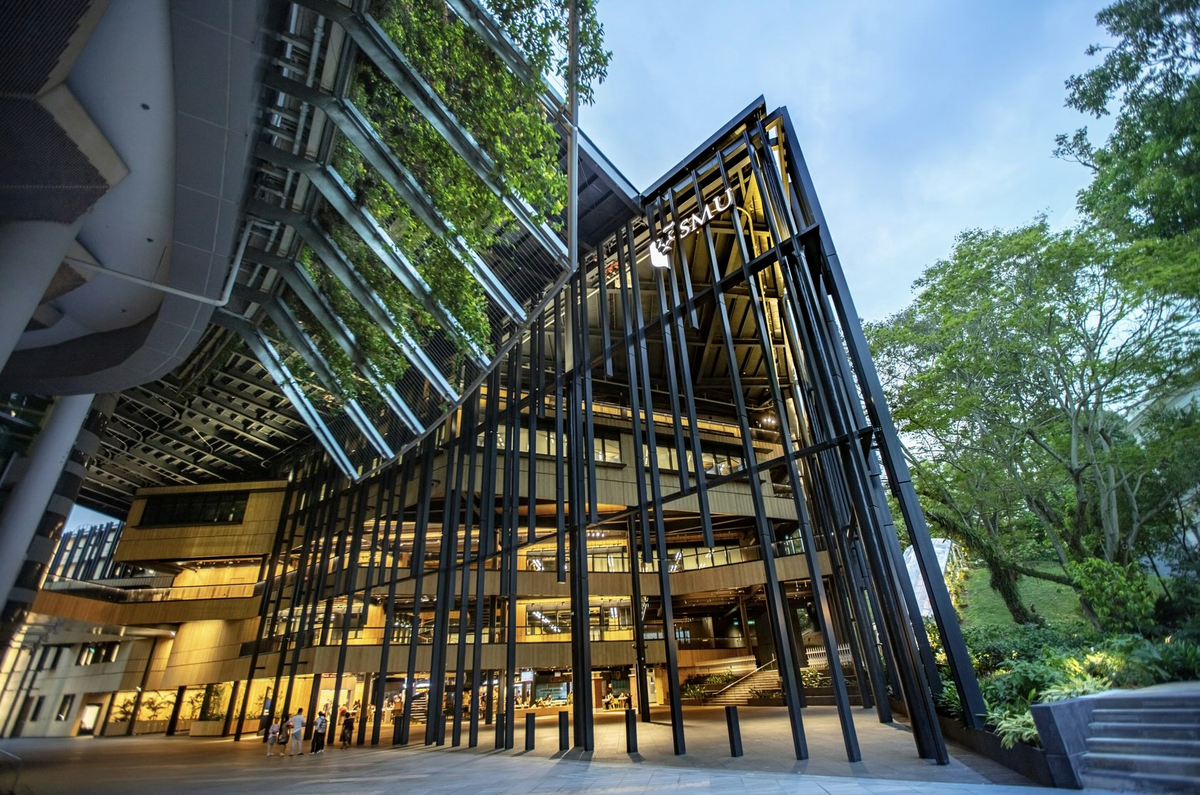
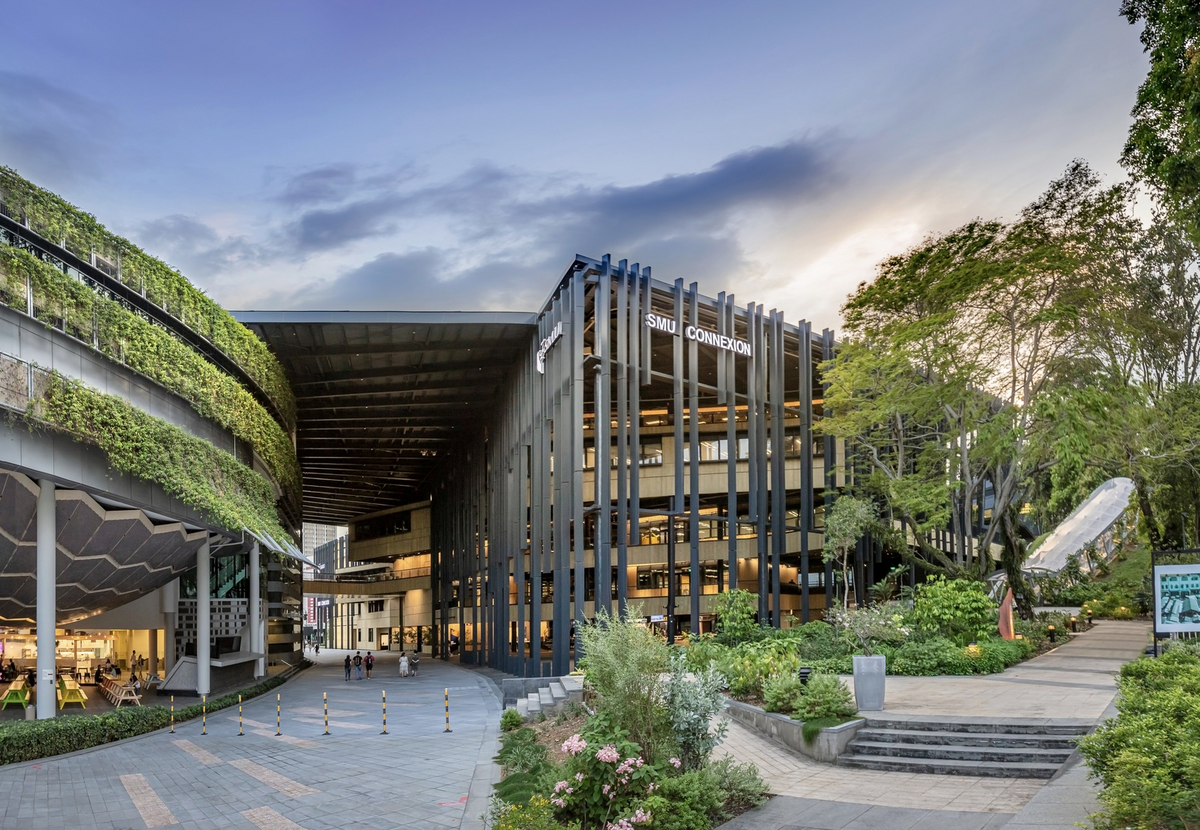
In the heart of Singapore’s bustling civic district, Singapore Management University’s newest addition, SMU Connexion, stands as a bold example of what a net zero energy institutional building can achieve in a dense urban environment. Completed in late 2019 and commissioned in January 2020, this landmark development at 40 Stamford Road combines elegant design, cutting-edge engineering, and robust sustainability strategies into a single cohesive whole. It not only fulfils the academic aspirations of the university but also reinforces its leadership in environmental responsibility.
Purpose-built to support the university’s SMU-X pedagogy, SMU Connexion has become a standout project in Meinhardt’s portfolio. Acting as both MEP and civil and structural engineers on the project, Meinhardt delivered technical solutions that were both innovative and efficient, helping the project achieve its ambitious environmental goals without compromising programme delivery or architectural intent.
The building focuses on experiential learning through real-world projects, and includes active learning classrooms, the bunks, collaborative zones, social pantry, jamming room, games lounge, integrated learning studios, makers space and student lounges. The ample active learning spaces promote socialising and enable students’ meetings with industry practitioners and faculty.
Purpose Built with Purpose
The client for the project, Singapore Management University, sought to create a forward-looking institutional building that would demonstrate sustainability leadership while supporting modern pedagogical needs. With Sundar Selvam, Vice President, Campus Infrastructure & Services representing the university, a clear and ambitious brief was communicated to all stakeholders from the outset.
This clarity was pivotal to aligning the design, engineering, and construction teams toward a common vision.The resulting building is an institutionally focused facility, equipped to serve as a high-quality academic environment. Its completion marked a significant milestone not only for the university but also for Singapore’s sustainable building movement.
A Net Zero Milestone
SMU Connexion’s environmental credentials are formidable. It is one of the first institutional buildings in Singapore’s dense city core to achieve net zero energy status. During the design phase, the building was projected to consume 545 megawatt-hours (MWh) of energy annually while generating 560 MWh through on-site solar photovoltaic systems. In 2022, the building consumed 709 MWh and produced 568 MWh.
These outcomes were instrumental in earning the project the BCA Green Mark Platinum Zero Energy certification, along with WELL certification and several prominent awards. These include the SGBC and BCA Leadership in Sustainability Awards, the Urban Habitat award by the Council on Tall Buildings and Urban Habitat, and the International Green Gown Award commendation for “pioneering the net zero energy revolution.”
Engineering Innovation at the Core
Central to the building’s environmental success is its use of enhanced Passive Displacement Cooling (ePDC), an innovative air conditioning system that relies on natural air stratification to cool spaces efficiently. Unlike conventional systems that depend on energy-intensive fans, ePDCs use natural convection, thereby drastically reducing operational energy consumption.
To optimise the system, computational fluid dynamics (CFD) simulations were conducted, alongside physical mock-ups. These analyses demonstrated that a dual-coil, back-to-back configuration with an intermediate channel was the most effective solution for thermal comfort. The result is a high-performing cooling system that operates with minimal mechanical input.
The ePDC system is complemented by integrated smart Internet of Things sensors and control systems, allowing for real-time environmental monitoring and optimisation. Combined with high-efficiency photovoltaic panels, these elements work together to support the building’s net zero mandate.
Digital Collaboration and Modular Execution
Collaboration played a vital role in the project’s delivery. The design and construction process leveraged Building Information Modelling via the BIM 360 platform, allowing all key stakeholders to work from a single digital model. This platform was essential in identifying potential conflicts early, streamlining coordination, and supporting the Design for Manufacturing and Assembly (DfMA) strategy employed for the building’s MEP systems.
The DfMA approach featured both vertical and horizontal modular MEP elements, fabricated offsite and assembled quickly on-site. This process not only ensured high-quality installations but also contributed to a significant reduction in construction time. Originally scheduled for 24 months, the construction programme was completed in just 15 months – a 40 percent time saving.
This achievement was made possible through meticulous planning, strong cooperation between consultants, the contractor, and the client, and the use of advanced modelling tools. The fast-track timeline was met without sacrificing quality or exceeding budget, a notable feat in a project of this complexity and innovation.
Balancing Function and Aesthetics
Despite the project’s technical ambitions, architectural quality was never compromised. In fact, certain MEP services were intentionally left exposed in visible areas to serve as design statements, celebrating the building’s high-performance infrastructure. In other spaces, services were concealed behind panels or within ceiling voids and painted to blend with architectural finishes.
This balance between visibility and discretion ensured that the building’s aesthetic language remained cohesive while highlighting the integrated nature of its engineering systems. The approach demonstrates a pragmatic reconciliation between sustainability objectives and architectural expression, where functional elements contribute meaningfully to the design narrative rather than detracting from it.
Lessons for the Future
SMU Connexion offers a powerful template for future net zero developments, particularly in urban contexts where space, time, and energy performance are in constant tension. It illustrates that sustainable buildings can be compact, attractive, and highly functional, provided they are supported by early interdisciplinary collaboration and a willingness to embrace new construction methodologies.
The project also highlights the critical importance of investing in design. By allocating time and resources to simulations, coordination, and modular prefabrication strategies, the team was able to unlock downstream efficiencies that translated into real-world savings in time, cost, and carbon.
A Model Institutional Development
As one of Singapore’s leading educational institutions, SMU has underscored its commitment to sustainability with this project. The client’s active involvement throughout the process ensured that both operational and aspirational targets were met. In particular, the university’s commitment to net zero outcomes and high-quality execution helped the project team maintain clarity and focus from inception through to completion.
The building’s success has not gone unnoticed. In addition to its environmental certifications and awards, SMU Connexion has been praised for its innovative mechanical systems, smart building technologies, and exemplary stakeholder integration. As a result, it now stands as a benchmark not only for institutional buildings in Singapore but also for urban net zero developments more broadly.