CapitaLand Development and Climate Group’s ConcreteZero initiative launched the Concrete Data for Concrete Action benchmark, Singapore’s first market-wide reference for examining the carbon footprint of concrete. The benchmark establishes a credible baseline for the embodied carbon intensity of concrete supplied in Singapore, giving the construction value chain a single, shared starting point for the first time.
Developed through collection and analysis of verified environmental data from concrete suppliers, the benchmark represents a weighted average of embodied carbon performance across commonly used concrete mixes. With the benchmark as a shared rulebook, the value chain is able to identify and choose lower-carbon concrete options. It aligns stakeholders across the built environment on reducing embodied carbon emissions together.
This transparency empowers demand and supply-side industry stakeholders to make informed decisions, while providing policymakers with the additional data to support standards across public and private projects. This alignment is urgently needed. The built environment accounts for almost 40 percent of global carbon dioxide emissions, with concrete alone accounting for 8 percent. By equipping developers, suppliers, regulators and financiers with a common reference point, the benchmark accelerates the transition from isolated pilot projects to systematic market adoption, reducing embodied carbon in construction at scale.
As Singapore imports most of its construction materials, the benchmark’s findings extend beyond the city-state, facilitating the wider Asian supply chain transition towards sustainable developments. The report draws on frameworks from the UK and Australia, adapted for Singapore’s market to ensure the data is internationally robust and regionally relevant.
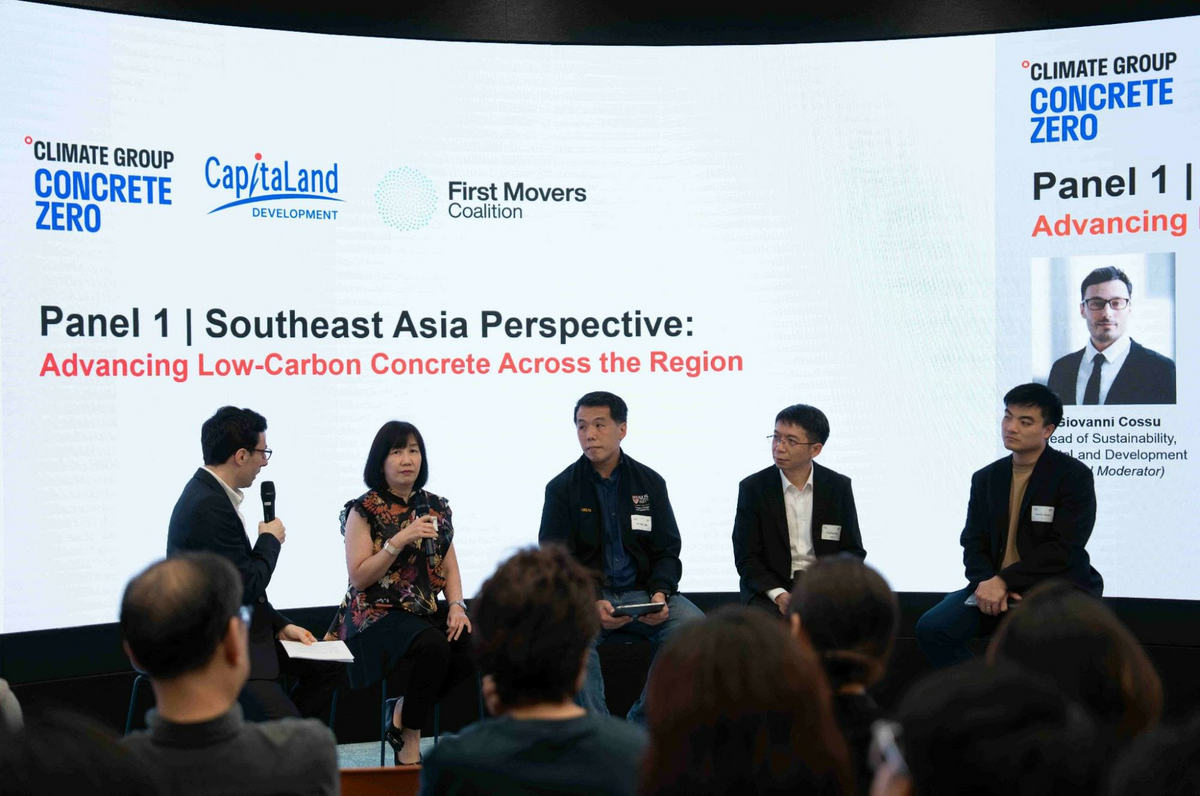
Mike Pierce, Executive Director, Systems Change at Climate Group, says: “Singapore’s embodied carbon benchmark is a critical step forward for Southeast Asia’s built environment. As the country’s first standardised measurement framework for concrete, it gives industry the transparency needed to make informed decisions about low-carbon materials. This exemplifies how government-industry collaboration can accelerate the transition to net zero construction and provides a clear and replicable model for other countries to follow.”
Tony Tan, Chief Corporate Officer at CapitaLand Development, says: “Developing high-quality spaces that support construction decarbonisation begins with making responsible choices at every stage, including what we build with. This benchmark provides the market with a reference tool to recognise and value low-carbon concrete. By aligning developers, suppliers, financiers and policymakers around shared data, it accelerates adoption at scale and helps buyers and investors identify buildings that will remain competitive as sustainability standards rise. This is what building for the long term looks like in practice to CapitaLand Development.”
Tan Chee Kiat, Deputy CEO for Industry Development at the Building and Construction Authority, says: “The findings from this industry-led study signal Singapore’s success in adopting low-carbon concrete. These insights will provide a roadmap for our stakeholders as they transition towards low-carbon developments. I am heartened to see our collective efforts in embodied carbon, supported by carbon management initiatives like the Singapore Building Carbon Calculator and the Green Mark Whole Life Carbon badge, delivering an impact on our built environment.”
Andrew Minson, Director Concrete and Sustainable Construction at Global Cement and Concrete Association (GCCA), says: “The GCCA concrete carbon ratings developed with UNIDO IDDO are designed to be used with local data, and so we enthusiastically welcome the work to establish the current embodied carbon of concrete in Singapore classified by strength. Local current data with global static ratings is the foundation for consistent low-carbon procurement to send meaningful design signals for suppliers.”
Yvonne Soh, Chief Executive Officer at Singapore Green Building Council, says: “The concrete benchmark validates Singapore Green Building Council’s long-standing efforts in market transformation for sustainable products. By quantifying baseline emissions across the various concrete strength grades, we can now accelerate the transition to low-carbon concrete with greater strategic purpose and evidence-based action.”