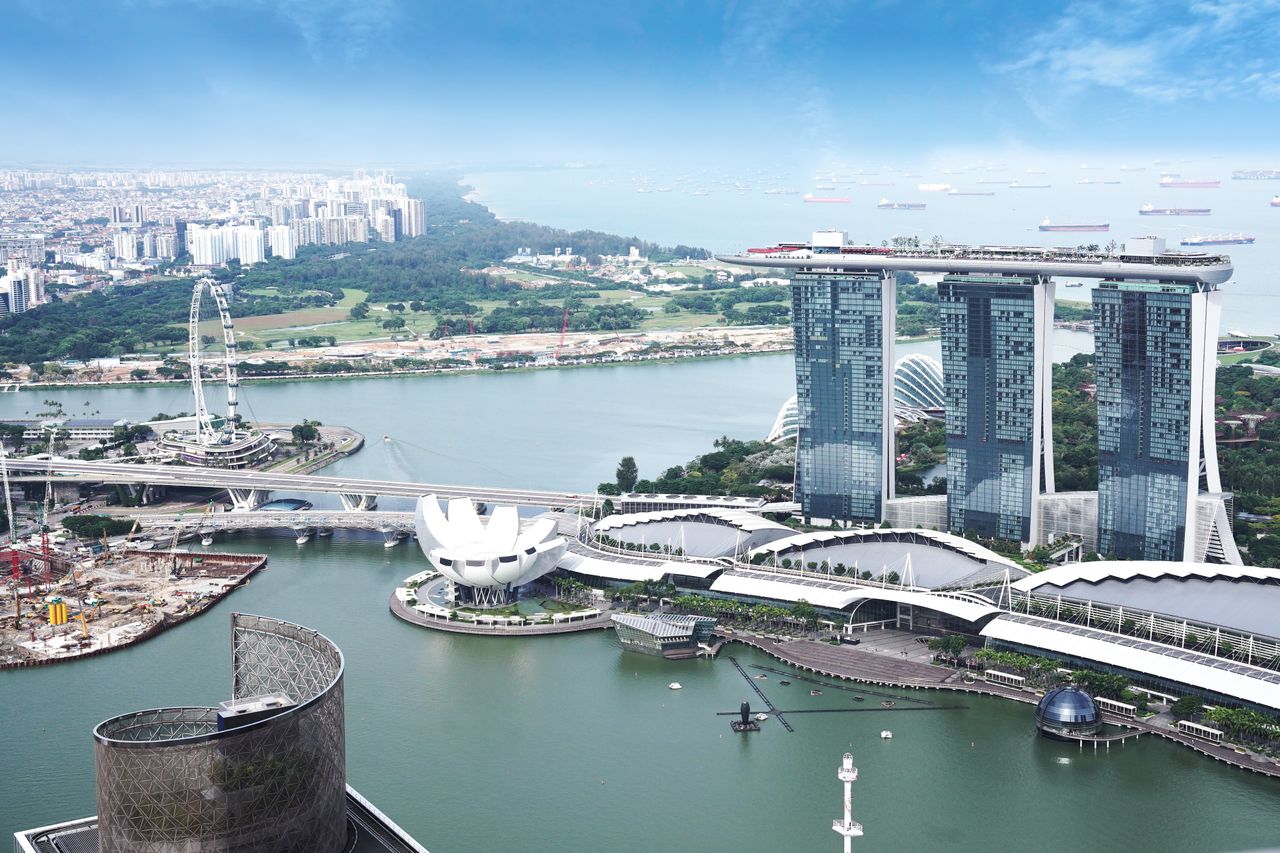
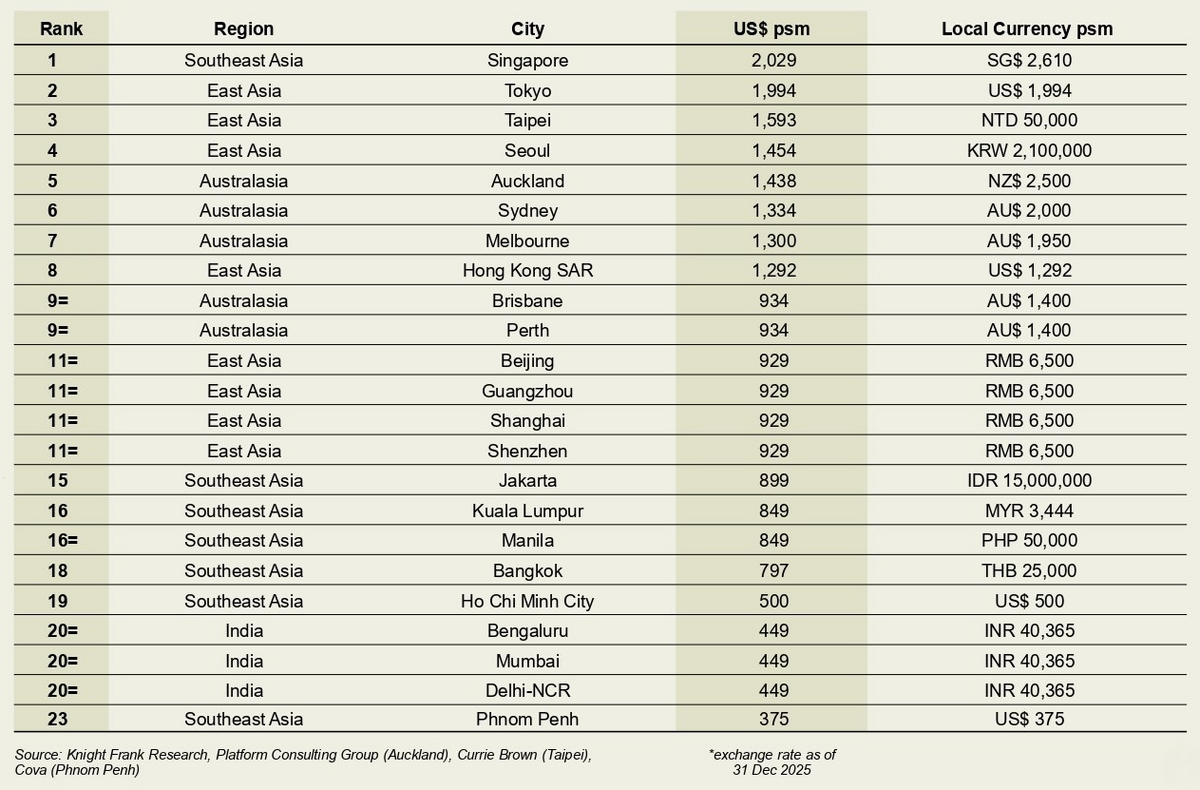
Singapore has ranked as the most expensive city for office fit-out in Asia-Pacific, according to Knight Frank’s Asia-Pacific Fit-Out Cost Guide 2026. At an average of US$2,029 per square metre, Singapore’s fit-out costs edge ahead of Tokyo (US$1,994 psm) and Taipei (US$1,593 psm). Phnom Penh, at US$375 psm, sits at the other end of the range, a spread that illustrates just how varied workplace investment conditions are across the region.
The guide covers 23 cities across Australasia, East Asia, Southeast Asia, and India, benchmarking fit-out costs at three specification levels: basic, mid/standard, and high/premium. Produced in partnership with specialist cost consultants including Platform Consulting Group, Currie Brown, and Cova, it draws on market data gathered during Q4 2025.
Across most markets, fit-out costs are expected to rise by 2 to 5 percent over the next 12 months. The pressure is coming less from broad inflation, which has eased across much of the region, and more from structural factors such as a tight construction labour market, growing competition for skilled trades, and tightening sustainability and compliance requirements.
Sustainability requirements are no longer a nice-to-have; they are now an expectation. Across Asia-Pacific, green building certifications, energy monitoring, and tighter material compliance are raising baseline fit-out costs. In markets such as Singapore and Sydney, an ESG-aligned fit-out is increasingly the starting point, not the upgrade, pushing demand for specialists in sustainability systems and smart workplace technology into an already tight labour market.
The guide also identifies a pronounced shift towards the Design & Build (D&B) delivery model, particularly for small- to mid-sized offices in the 900–2,800 sqm range. By consolidating design and construction under a single contract, D&B transfers cost-overrun risk to the contractor and provides greater pricing certainty, an increasingly valued advantage in volatile labour and materials markets. Knight Frank estimates that D&B can compress project timelines by 20 to 30 percent compared with traditional sequential delivery, a significant consideration for occupiers in fast-moving sectors.
Tim Armstrong, Global Head of Occupier Strategy and Solutions, Knight Frank, says, “Workplace decisions across Asia-Pacific are being made in a more complex environment than we have seen in some years. Occupiers are managing fit-out cost pressures from multiple directions: labour, sustainability requirements, and now the added uncertainty of how trade tariffs may affect material costs and supply chains. Our advice to occupiers is to engage early, clearly lock in scope, and build flexibility into procurement strategies. Those who do will be better placed to manage both cost and delivery risks.”
In Singapore, increased labour costs, constrained contractor capacity, and stringent building and sustainability standards drive its position at the top of the regional cost table. High/premium fit-outs in the city-state command a substantial premium relative to the rest of Southeast Asia, reflecting its status as a regional financial and business hub where occupiers continue to prioritise workplace quality and employee experience.
India’s three major office markets, Bengaluru, Mumbai, and Delhi-NCR, remain among the most cost-competitive in the region, with broadly consistent pricing across all specification levels. Markets including Jakarta, Kuala Lumpur, Manila, and Bangkok represent a transitional tier, where rising quality expectations and regulatory requirements are pushing mid/standard and high/premium costs gradually higher.
Currency volatility and import duties, which vary from zero to above 30 percent across the region, remain a material risk for fit-out budgets reliant on imported components. The guide notes a shift among occupiers towards proactive supply-chain planning: qualifying local suppliers and substituting imported materials with regionally sourced equivalents during the design phase. The approach reduces cost exposure and lead times while lowering the fit-out’s carbon footprint.
Christine Li, Head of Research, Asia-Pacific, Knight Frank , adds, “The cost picture across Asia-Pacific is more nuanced than the headline numbers suggest. Labour constraints and ESG requirements are raising the floor for what a competitive fit-out costs, even in markets that were historically considered affordable. At the same time, global trade dynamics, including the ripple effects of tariffs on materials and supply chains, are introducing uncertainty that occupiers need to factor into their planning. Early engagement and clear scope definition remain the most effective tools for managing that risk.”
Francesco Demarco, Head of Global Portfolio Solutions, Asia-Pacific, Knight Frank, adds, “For occupiers managing portfolios across multiple Asia-Pacific markets, the challenge is no longer simply controlling fit-out costs; it is understanding why those costs are moving and what that means for long-term portfolio strategy. The return on capital investment is increasingly harder to justify. Labour constraints, sustainability compliance, and trade-related material pressures are structural; they will not resolve quickly. Therefore, the smart approach is to integrate fit-out planning into broader portfolio decisions from the outset, aligning specification levels with business requirements, and using cross-market cost data to make more informed capital investment decisions.”