Safdie Architects, with Anishinabe Design, PWP Landscape, and the Cherokee Nation, have unveiled the design for the reimagined Cherokee Heritage Centre in Tahlequah, Oklahoma, the capital of the Cherokee Nation. Established in 1967 by the Cherokee National Historical Society on the grounds of the former Cherokee Female Seminary, the Heritage Centre served for more than five decades as the Nation’s principal cultural institution before closing in 2020.
The new campus will transform the 43-acre site into a centre for history and culture with a new museum, educational and genealogical spaces, communal gathering areas, and a research centre. Over a multi-year engagement with the Nation, Safdie Architects’ developed a design that protects and preserves the legacy of the site while building upon it for the future in a way that integrates the project into the existing landscape.
“As we have worked to reenvision the future of CHC, we knew we needed partners who would do more than deliver a design. We wanted a team that would listen, care and who would walk alongside us on this journey. That’s exactly what Moshe Safdie and his team have done,” said Christine Neuhoff, Cherokee National Historical Society chairperson.
“They have approached this work with humility, with genuine curiosity and with a deep respect for Cherokee culture and history. They took the time to be present, to learn from our people, and to build trust through collaboration. Their commitment to listening and to getting it right is reflected in every detail, and we could not be more appreciative.”
Safdie Architects conceived the new Cherokee Heritage Centre as a series of pavilions, nestled within the tree line and organised along a newly created crescent-shaped creek that traverses the site. The initial phase of the project includes exhibit and community spaces housed in pavilions of varying shapes and sizes, resulting in a series of experiences that are interwoven into the landscape. The tallest of the pavilions rises above the trees to serve as a beacon on the site and welcomes visitors as they approach the Heritage Centre. The solid walls of the pavilions are cast with materials that evoke the color and layering of an earthen structure.
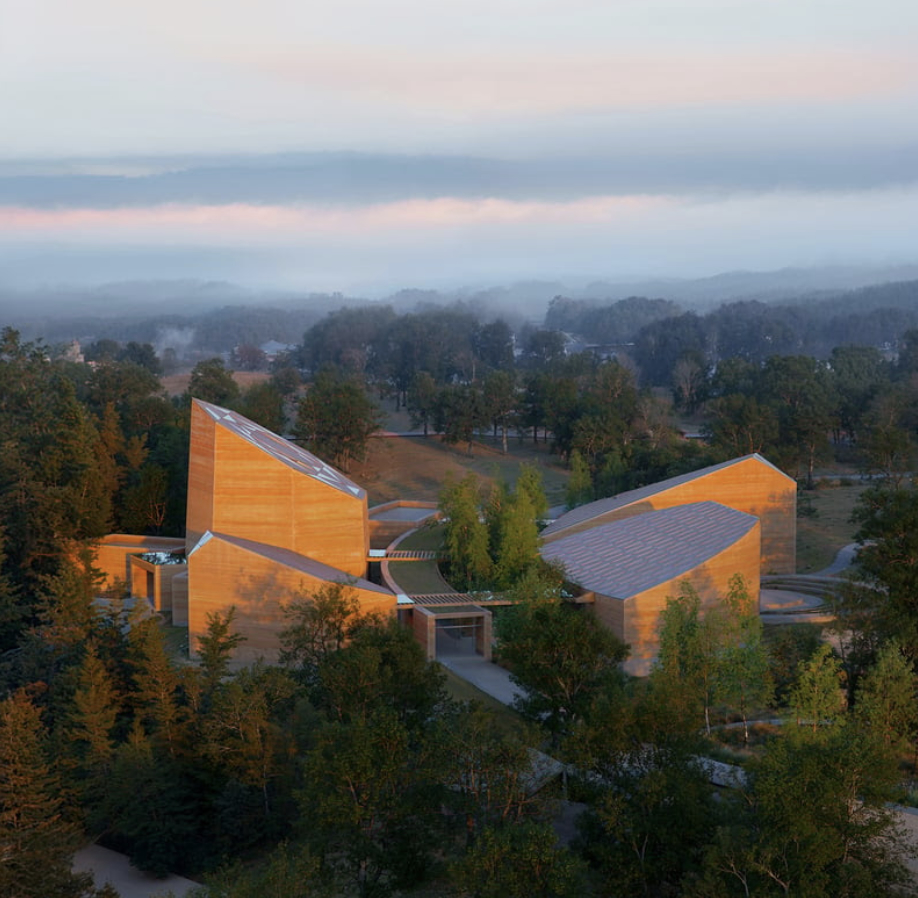
“With respect and admiration for the Cherokee Nation’s culture, the design draws inspiration from the historic site,” said Moshe Safdie, Founding Partner of Safdie Architects. “Pavilions are arranged in response to the land, structures are immersed within the wooded landscape, and the story of the Cherokee Nation is integrated throughout—creating a setting that fosters connection, belonging, and continuity between the Cherokee people, their history, and their land.”
The creek, which is fed by rainwater harvested from the abutting pavilions, stitches together the diverse elements of the new centre, integrating native plantings and exhibits into one cohesive experience. At the centre of the site stand the three remaining columns of the first Female Seminary—whose footprint is reimagined as a gathering place to commemorate the ground’s importance. Moving away from the Heritage Centre, the site opens with interpretive trails that unite the project with a reconstructed Diligwa village, and other existing site features such as the Tsa-La-Gi amphitheater, designed by the first AIA recognised Cherokee architect Charles ‘Chief’ Boyd.
“It has been an honour to work with the Cherokee Nation to reimagine the Heritage Centre and its grounds,” said Jaron Lubin, Senior Partner at Safdie Architects. “From the outset, we listened and learned from Cherokee voices, which shaped a design rooted in respect for the land and culture. We hope this new campus will serve as both a homecoming for the community and a place of discovery for future generations.”
The Cherokee Heritage Centre continues the firm’s history of designing impactful cultural spaces that are embraced by their respective communities, exemplified by projects such as the Kauffman Centre for the Performing Arts in Kansas City, the Skirball Cultural Centre in Los Angeles, and the Crystal Bridges Museum of American Art in Bentonville, whose expansion, also designed by Safdie Architects, is scheduled to open in June 2026.