Immersive lighting is rewriting the role of the interior surface, turning walls from passive backdrops into architectural, atmospheric and even interactive storytellers. Malcolm Fooh, product sales professional at Acoustic & Lighting Systems Pte Ltd, explains why the next generation of lighting will be judged not only by how brightly it performs, but by how intelligently it belongs.
It illuminates the room, satisfies practical requirements, controls glare, meets energy targets and then retreats politely into the ceiling. It does not simply reveal architecture; it enters the architecture, occupies its surfaces and contributes to the story a space is trying to tell.
Malcolm Fooh, product sales professional at Acoustic & Lighting Systems Pte Ltd, defines it plainly: “To me, immersive interior lighting is lighting that becomes part of the architecture and the narrative of a space, rather than sitting on top of it.” Conventional lighting design remains largely concerned with illumination: ensuring a space is bright enough, evenly lit and code-compliant. Immersive lighting adds movement, texture, colour and content until the surface itself becomes part of the experience.
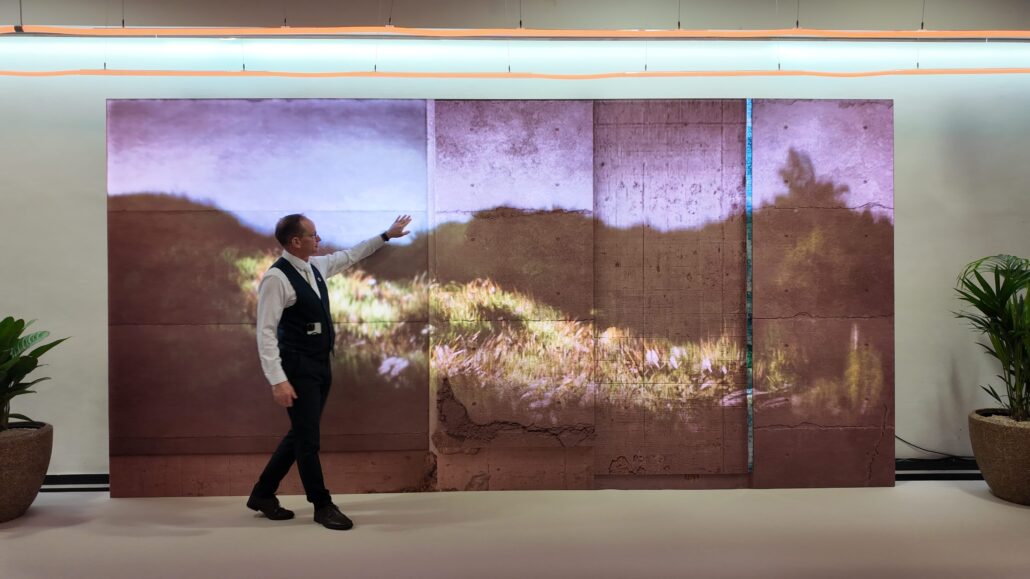
That distinction is central to CECOCECO’s ArtMorph Grande, a textured luminous panel that Fooh exhibited recently and uses to illustrate the category’s wider direction. Here, the wall is no longer merely the recipient of light. It can become the source, changing from a warm architectural material into an animated visual moment and then returning to its quieter material state.
This shift has been mirrored in client conversations. Five years ago, Fooh recalls, briefs tended to begin with lux levels, glare control and energy compliance. Today, clients are more likely to arrive asking for a “wow factor”, something “Instagrammable”, or a moment that visitors will remember.
During demonstrations of ArtMorph Grande, questions centred less on foot-candles than on whether the wall could tell a brand story, change with the seasons or greet people differently over the course of a day. Many visitors assumed that a projector must have been concealed somewhere, throwing images onto the surface. There was no projector.
Several pressures are converging. Social media has made visual distinction more valuable; hospitality and retail have raised expectations around experience design; and wellness thinking has sharpened awareness of the relationship between light, mood and behaviour. At the same time, products have made layered, content-led lighting more commercially practical. Modularity, low standby power and a five-year warranty allow atmosphere, reliability and sustainability to sit in the same specification.
From Line Item to Identity
Lighting’s expanded role is visible across several interior sectors. In hospitality, it shapes the first impression of a lobby. In retail, it frames merchandise and reinforces brand identity at the entrance. In corporate and commercial experience centres, it is expected to communicate innovation without abandoning calm. Residential feature walls are also absorbing expectations first cultivated in public-facing spaces.
Fooh distils the shift: “Lighting has moved from being an engineering line item to being a design and branding tool.”
ArtMorph Grande is designed for this architectural scale. Its 6.2 mm pixel pitch enables it to operate as a statement surface viewed across a lobby or atrium, rather than only as a screen approached at close range. The point is not to smuggle a television into the finishes schedule under a more flattering name. It is to create a surface whose visual and material role remains legible as part of the interior.
That ambition works best when lighting is considered early. Experienced architects and interior designers tend to build feature lighting into the concept from the first day, coordinating structural provisions, power routes and content strategy before the design hardens around them. Yet large-format luminous walls still arrive late on many projects, often after what Fooh calls the “blank wall problem” has become rather difficult to ignore on site.
Late decisions normally come with expensive consequences, but a simple modular mounting system can reduce the damage. ArtMorph Grande uses a frame-and-magnetic-panel arrangement that does not demand the extensive infrastructure changes associated with conventional AV walls. The more rigorous sequence begins with architecture and sightlines.
Fooh first considers where people enter, pause and look upwards, because these movements establish the relevant scale and viewing distance. The desired mood follows, then the interior concept and material palette. ArtMorph Grande is available in different pixel pitches for different viewing distances, while more than 200 texture covers span wood, stone, textile and metal finishes. The architecture and emotional intention therefore need to be understood before the correct surface treatment can be chosen or a texture customised to suit.
This is immersive lighting as spatial design, rather than decorative equipment selection. Viewing distance affects resolution. Arrival patterns identify the moments that matter. The emotional objective steers the content. Material choice determines whether the luminous wall should settle into the room, contrast with it or appear to change character altogether.
The Narrative Layer
A well-resolved lighting scheme still begins with the established layers of ambient, task and accent lighting. Ambient and task light support comfort, visibility and function. Accent lighting gives form to the architecture. Immersion arrives through an additional layer: content, or narrative.
Fooh describes the framework directly: “I think in terms of ambient, task, accent, and ‘content’ or narrative layers. Ambient and task lighting handle comfort and function. Accent lighting sculpts the architecture.”
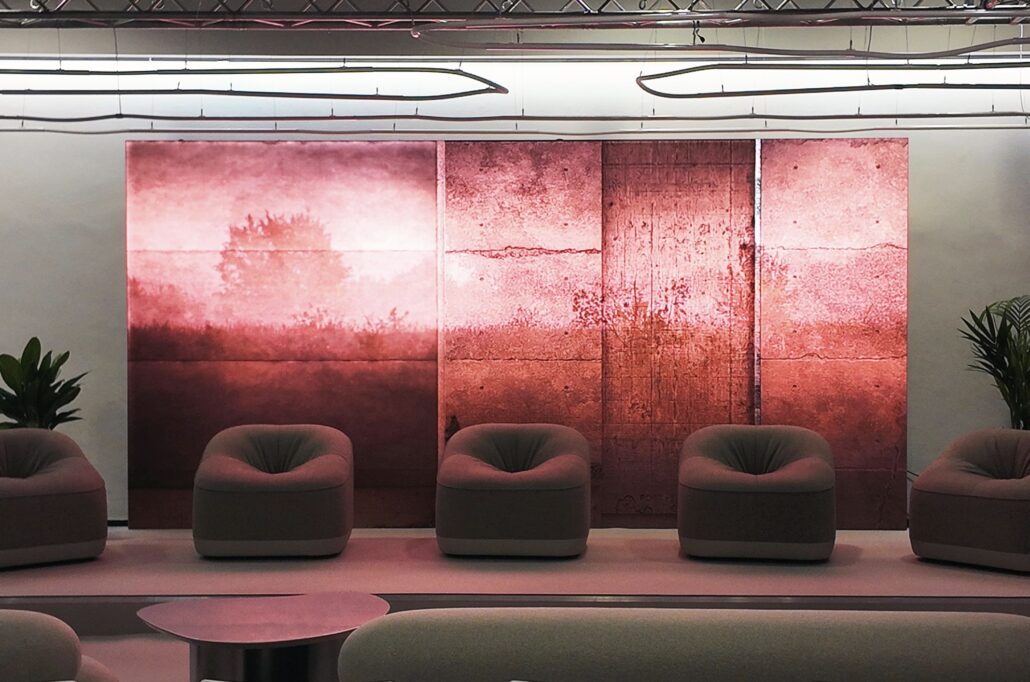
The narrative layer then introduces dynamic, content-driven light that can change over time. This narrative layer does not excuse the designer from practical responsibilities. Safety, wayfinding and task visibility remain non-negotiable, with atmosphere constructed around them rather than placed in competition with them. The useful trick is to make the feature wall work even when its dynamic content is dormant. A textured physical cover allows the surface to read as deliberate architecture instead of collapsing into the familiar dead-black rectangle of a switched-off display.
That off-state performance is more than cosmetic. Immersive interiors depend on contrast, shadow, warmth and indirect light to establish depth and emotional tone. Uniform illumination can flatten a room into forgettability. Shadow and contrast create drama, warmth calibrates feeling, and concealed or indirect sources allow atmosphere to be perceived without the fixture loudly explaining itself.
Material selection further shapes the result, while ceiling height alters throw distance and therefore fixture selection, while furniture layout determines where occupants actually stand, sit and look.
A More Demanding Client
Clients may be more visually literate, but visual literacy is not the same as technical fluency. Many can point to a hotel lobby or airport wall and identify the feeling they want. However, translating that feeling into pixel pitch, viewing distance, brightness, energy draw and an appropriate luminous surface still requires guidance.
“But there’s still a gap in understanding the technical trade-offs behind that feeling: pixel pitch versus viewing distance, brightness versus energy draw, or why a textured luminous panel behaves differently from a plain video wall,” Fooh explains.
Clients are also asking different questions. Content flexibility is increasingly important: a surface should be capable of changing for a season or campaign without the wall being demolished and rebuilt. Energy use, material sustainability and maintenance costs are now entering discussions earlier, before design approval rather than after it.
ArtMorph Grande addresses those concerns by separating its replaceable covers from the LED core. The aesthetic layer can be refreshed independently instead of being discarded wholesale. Sustainable cover materials and a five-year warranty support a longer usable life. Each panel draws roughly 60W on average and 2.5W in standby, limiting its running footprint over years of operation.
This also challenges two persistent misconceptions. The first is that immersive lighting must mean a large, permanently active video wall that becomes visually awkward the moment it is switched off. The second is that dynamic, content-based lighting must be both power-hungry and maintenance-heavy.
Fooh names both assumptions: “The biggest misconception is that immersive lighting has to mean a big, always-on video wall that looks jarring the moment it’s switched off. Another is that dynamic content-based lighting is inherently a high-energy, high-maintenance choice.”
A surface designed to resemble an intentional architectural material in its inactive state offers a direct rebuttal. Low standby consumption and front-access modular servicing address the operational half of the argument. The wall need not blaze continuously to justify its existence, nor should a fault require the entire composition to be dismantled.
The appetite for such surfaces has travelled quickly, and social media, says Fooh, has “turned striking interior lighting into shareable content, and hospitality brands have leaned into that by commissioning statement walls specifically because they photograph and film well. That expectation has trickled down into corporate lobbies, retail flagship stores and even residential feature walls.”
Designing for Reality, Not Merely the Reveal
The glamorous image of immersive lighting is the finished wall in full performance. The less glamorous reality involves structural mounting, power, data, servicing, dust, deadlines and several trades discovering that they have all been designing the same square metre from different directions.
“Retrofitting into a finished interior usually means limited access to structural power and data runs, and very little tolerance for disruption or dust. Tight renovation timelines compound that because there’s no room for lengthy commissioning,” says Fooh.
Yet installation speed cannot compensate for every planning error. Feature walls are too often treated as flat planes, with insufficient thought given to how they will appear when switched off, viewed from an oblique angle or opened for maintenance. Power and content infrastructure may also be under-specified early, only for the project team to discover midway through construction that the wall cannot support the intended display. Fooh advises designers to prioritise front-access serviceability and systems with independent content and cover layers rather than printed GOB Modules.
Coordination is therefore not the dreary administrative appendix to design. It is one of the conditions that makes the visual result possible. A luminous feature wall touches the structural mounting system, electrical infrastructure, AV content pipeline and interior finishes schedule simultaneously. If architects, interior designers, lighting specialists, electricians and contractors work in isolation, the wall is unlikely to land as intended.
Fooh is unequivocal about coordination: “It’s essential, and in my experience it’s where projects most often lose time. A luminous feature wall touches structural mounting, electrical infrastructure, AV content pipelines and the interior finish schedule all at once, so if any one of those trades works in isolation, the wall doesn’t land as intended.”
Questions from architects and electricians on the exhibition floor were consequently as concerned with mounting, power budgets and content delivery as with appearance. That balance is instructive. Immersive lighting may trade in atmosphere, but atmosphere still needs cables, access and a coordinated drawing set.
From Changing Scenes to Responsive Spaces
The growing accessibility of smart lighting, dimming, sensors and colour-temperature controls is allowing single fixtures to serve multiple moods and purposes. A space can respond to occupancy, time of day or an operator’s cue rather than remaining locked into one static effect.
For example, ArtMorph can be synchronised remotely and integrated with sensing devices, creating the possibility of interactive, responsive behaviour instead of a permanently repeating loop.
This capacity returns lighting to the narrative question. A wall may greet visitors differently at different times, shift for a new campaign, respond to people nearby or settle into a quieter architectural state when animation is unnecessary. The technology is valuable not simply because it can move, but because it can choose when movement is appropriate.
Efficiency remains part of that judgement. Fooh sets out the criterion clearly: “I look for products where the ‘immersive’ effect doesn’t require the fixture to run at full brightness constantly, and where the materials and lifecycle are genuinely durable rather than disposable.”
The Surface Ahead
Fooh expects three developments to shape the next generation of interiors. The first is the rise of modular, serviceable luminous surfaces treated as upgradable materials rather than fixed installations. The second is deeper integration with sensors and interactivity, allowing rooms to respond to the people within them. The third is a continued push towards fixtures that look complete and considered when they are not displaying content.
Together, these shifts recast the luminous surface as a long-term architectural component: one that can be serviced, refreshed and reprogrammed as needs change, while continuing to contribute to the room during periods when no animated content is required.
The most persuasive immersive lighting does not behave like technology anxiously demanding applause. It works with sightlines, finishes, movement and mood; it supports practical visibility; it can evolve without being discarded; and it knows when to perform and when to become part of the wall again.
Or, as Fooh puts it, the category is moving towards a combination “rather than sheer brightness or screen size”. The wall of the future may still be solid, textured and materially convincing. It will simply have rather more to say.
_________

About Malcolm Fooh
Malcolm is a product sales professional at Acoustic & Lighting Systems Pte Ltd, specialising in professional lighting, video, and audio solutions for the live events and systems integration industry. With a strong technical foundation spanning multi-vendor AV environments, from LED display and projection systems to networking and show control, he bridges the gap between complex technical specifications and practical client solutions. His work involves close collaboration across lighting design, video engineering, and production teams to deliver integrated systems for exhibitions, venues, and large-scale events.