
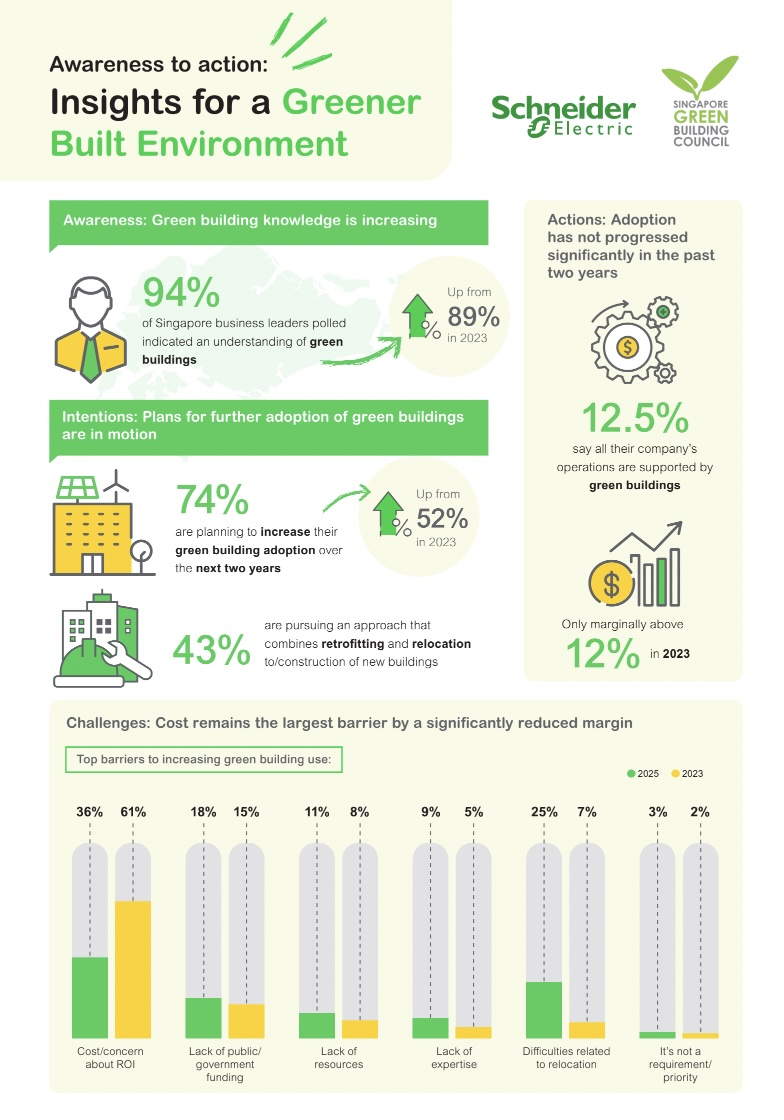
Momentum for Singapore’s green building sector is set to accelerate as higher levels of understanding and key technologies drive cost savings, according to a joint study by Schneider Electric and the Singapore Green Building Council (SGBC). Business leaders also indicated confidence that the rate of savings would rise over time, and said they are planning to increase their adoption of green buildings. This bodes well for Singapore’s Green Building Masterplan, which is to have 80 percent of buildings by gross floor area classified as green by 2030.
Green Building Technologies Delivering Cost Savings
The study suggests green building technologies are delivering both cost savings and emissions reductions, with respondents recording up to 20 percent in energy savings over the past 12 months. Digital twin solutions and AI solutions showed the most promise, with roughly a quarter of respondents reporting cost reductions of 30 percent to 49 percent.
As a result, cost is no longer as much of a barrier to green building adoption as it used to be. Just 36 percent of survey respondents cited cost concerns as a top barrier, down from 61 percent in 2023. Roughly four in five respondents have also achieved emissions reductions of more than 10 percent from energy efficiency technologies, renewable energy integration, building materials and design elements, and the installation of transport infrastructure.
As technologies improve and implementation levels rise, respondents also expect savings to increase over time. When asked to estimate their cost savings over the next 12 months, most respondents said they expected to see savings of up to 20 percent. When asked to estimate their savings over the next two years, however, most put the figure at 21 percent to 29 percent. Estimated savings rose further still over a five-year period, with an equal number of respondents predicting savings of 21 to 29 percent and 30 to 49 percent.
Holistic Approaches On the Rise
While sustainability targets and energy efficiency goals remain major drivers of green building ambitions, the study also found that business leaders are considering a wider range of factors. Eight percent of business leaders cited employee expectations as a top driver of green building adoption, up from 3 percent in 2023.
The proportion of business leaders citing regulatory expectations as the top driver also rose, to 10 percent from 2 percent. This could be attributable to Singapore’s Mandatory Energy Improvement (MEI) regime, which takes effect in the third quarter of this year. The MEI regime applies to energy-intensive buildings with a gross floor area of 5,000 square metres or more. Upon receiving an MEI audit notice, building owners must conduct an energy audit and develop an energy efficiency improvement plan.
Yoon Young Kim, Cluster President, Singapore and Brunei, Schneider Electric, said, “Singapore’s embrace of digital green building solutions has positive implications for our progress towards national net zero targets, as such solutions are highly scalable. As evidenced by our study, the environmental benefits of technological progress are real and significant. As a responsible member of the private sector, we look forward to contributing towards this green journey.”
Allen Ang, President, Singapore Green Building Council, said: “This survey reaffirms industry support for green building implementation. In the face of current headwinds, we believe green building adoption rates can be sustained and even increased by continuing momentum in green building regulation. Progressive upgrades to building standards should also be accompanied by targeted incentives that encourage retrofitting of older buildings, allowing Singapore to hit its 2030 targets.”