
As construction embraces the age of artificial intelligence, Novade’s CEO Denis Branthonne shares how predictive analytics and field-ready data are transforming safety from a reactive task into a proactive movement that could save lives and redefine how sites operate.
When Denis Branthonne, CEO of Novade, watched his first predictive model achieve more than 80 percent accuracy in forecasting accident risks, he knew construction’s digital era had reached a defining moment.
“That was a breakthrough moment for me,” he recalls. “It felt like a paradigm change –we could help teams anticipate risks before incidents happened.”
For an industry often defined by complexity, unpredictability, and risk, that moment of clarity carried weight. Construction has long wrestled with safety management that is largely reactive, not predictive. Yet Novade’s work suggests a future where technology doesn’t just record incidents but helps prevent them, one data point, one decision, one worker at a time.
From Data Chaos to Predictive Clarity
Branthonne’s conviction that artificial intelligence could empower frontline teams was born not from hype, but from hands-on breakthroughs. “There are many universities and research labs developing AI models for risk detection,” he says. “What sets Novade apart is that we were the first to operationalise these models at scale – across very large, complex projects – with high accuracy and reliability.”
That distinction between theory and field application is what defines Novade’s trajectory. Safety, for Branthonne, isn’t an abstract concept or a tick-box metric. It’s personal. “Being able to bring this innovation from theory into daily practice on construction sites is what makes it deeply personal for me,” he says.

But AI’s promise hinges on one essential ingredient: clean, reliable data. Construction sites, by nature, are messy ecosystems. Workers, subcontractors, weather conditions, and shifting project parameters make consistency difficult. Branthonne acknowledges that “data quality remains a massive bottleneck” across the industry.
Novade’s approach, however, has been pragmatic. “Over the years we’ve built a digital platform that excels in capturing structured, reliable field data,” he explains. That digital foundation, strengthened through multi-year pilots such as with Singapore’s Tiong Seng, ensures that AI models are trained on accurate, site-ready data rather than incomplete or fragmented inputs. “This foundation is what makes our AI outcomes trustworthy and actionable,” Branthonne adds.
The Anatomy of Construction AI
For Novade, artificial intelligence isn’t a single monolithic concept, it’s a toolbox. “In construction, there are actually different types of AI that can be used,” Branthonne says.
He distinguishes three key categories:
- Large Language Models (LLMs): Despite being cost-effective and useful for chatbots, data analysis, and content review, it requires careful handling to avoid inaccuracies.
- Video AI: Ideal for real-time monitoring and safety compliance, yet often cost-prohibitive and laden with privacy concerns.
- Predictive Models: Capable of forecasting risks, delays, or equipment failures, and when built on clean data, exceptionally accurate.
Novade’s primary focus lies with the third. “This is what we use to predict safety risks,” says Branthonne. “The common thread is data.”
In practice, this translates into a proactive approach to risk. Predictive models don’t just identify problems after the fact; they signal where and when accidents are statistically more likely to occur. “Predictive models can highlight that a particular activity or subcontractor profile is statistically riskier in the coming days,” Branthonne explains.
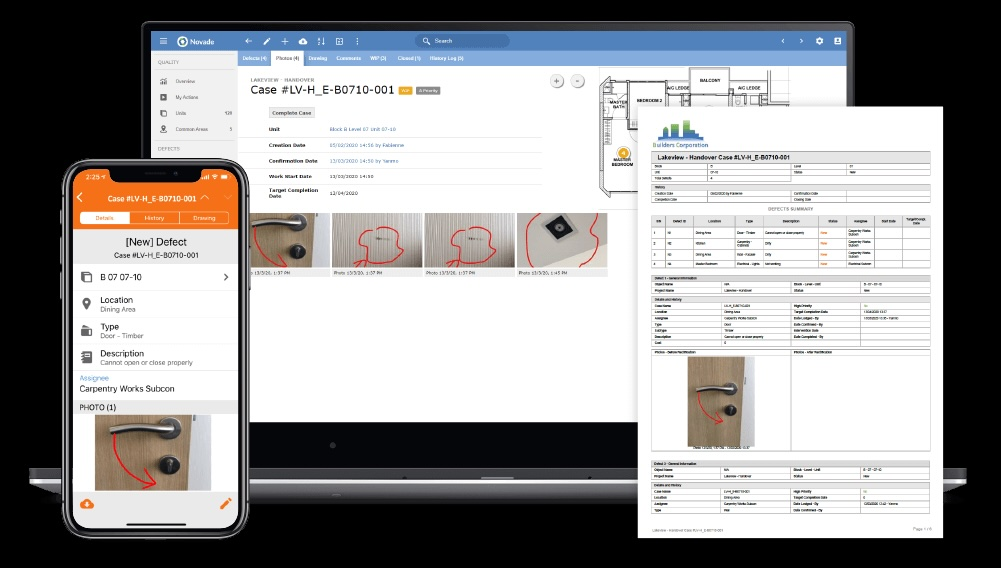
By contrast, “Video AI might catch someone entering a hazardous zone without PPE.” The two, he says, are complementary; one looking forward, the other looking live.
From Dashboards to Decision-Making
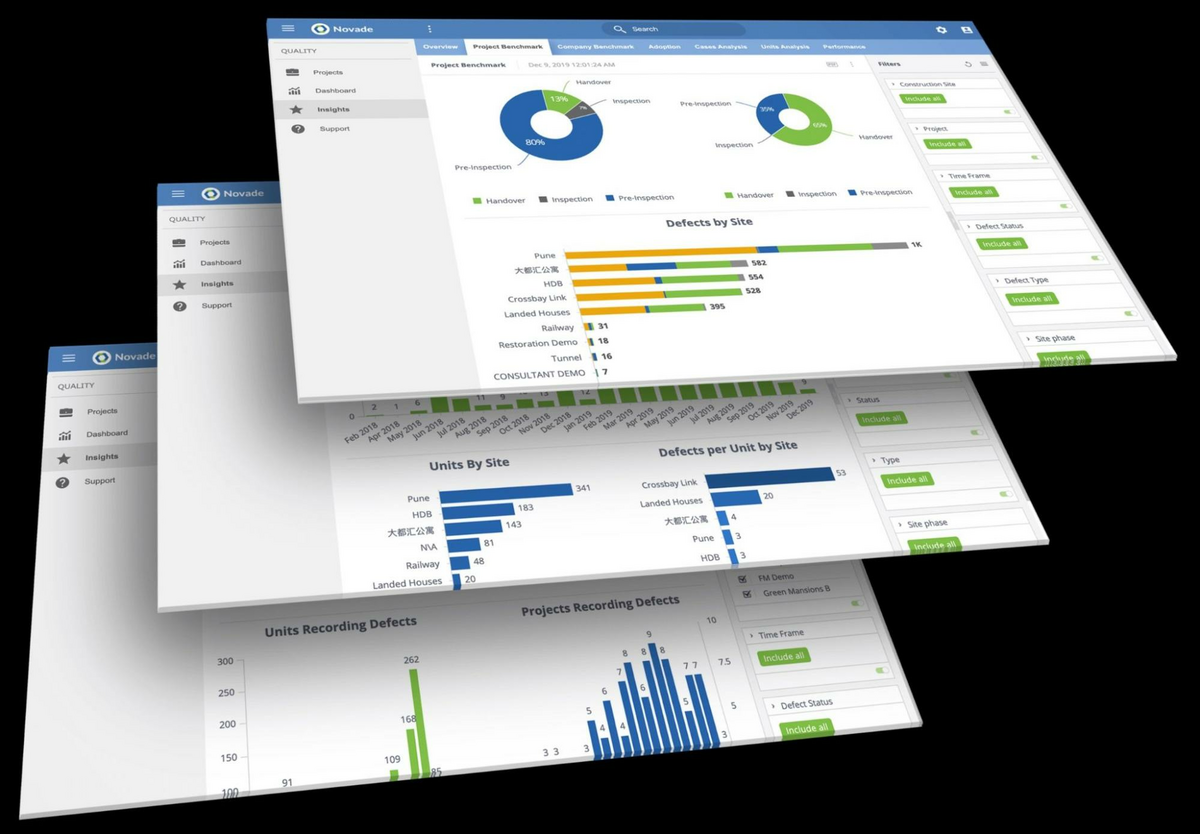
When Novade launched Novade Insights in 2021, the company added a new layer of intelligence to field operations. The platform visualises and analyses millions of records across sites, allowing project teams to monitor safety, quality, and productivity in real time. Working with Databricks, Novade was able to move from raw field data to engineered datasets with efficiency and security.
“Novade Insights allows clients to visualise and analyse millions of records across multiple sites and thousands of workers,” Branthonne explains. “Standard dashboards are available out of the box, but clients can also customise their views to track their own KPIs.”
This shift from spreadsheets to live dashboards is about more than convenience. It marks a cultural shift in how safety and performance are managed. For supervisors and executives, it translates complex risk probabilities into intuitive insights.
“At first, we presented risks as percentages,” Branthonne admits. “Teams found that too abstract. Switching to simple, visual indicators — green, amber, red — made the insights instantly actionable. When the dashboard turns red, everyone knows it’s time to act.”
Empowering the Frontline
Branthonne’s vision for AI is not about replacing human expertise. “Our models provide insights — for example, highlighting when risk levels rise on a specific site,” he says. “But decisions always remain with human supervisors. We see AI as an assistant, not a replacement.”
This “human-in-the-loop” philosophy underscores Novade’s commitment to empowerment over automation. “The goal is to make safety teams more informed, while ensuring they stay in full control,” he explains.
That ethos extends to the company’s newest development: Noa, the AI field-assistant.
“Right now, Noa primarily helps site administrators by simplifying system setup and guiding them on product functionalities,” says Branthonne. “It’s like having an AI coach at your side.” The next phase, he adds, will bring Noa closer to the frontline, “helping crews log issueshands-free.”
Digitisation in construction often stumbles not because of technology, but because of culture. Site managers and foremen, shaped by decades of analogue processes, can be resistant to change. Yet Branthonne insists that adoption has less to do with age and more to do with practicality.
“Field teams will adopt digital tools only if they clearly make their jobs easier,” he says. “That means mobile-first design, offline capability, and aligning with how people actually work, not forcing them to change established routines.”
And sometimes, the most seasoned professionals are the quickest converts. “Interestingly, age is rarely the barrier,” he notes. “Some of the most seasoned professionals are the quickest to see the value in digital tools, because they know exactly where inefficiencies and risks lie.”
Beyond Safety: AI’s Expanding Reach
While predictive safety has been Novade’s flagship innovation, Branthonne sees a broader horizon emerging. “AI is already branching into multiple areas of construction management,” he says.He outlines several frontiers:
- Quality Assurance: Using computer vision to analyse cracks or damages, while LLMs automate inspection documentation.
- Progress Tracking: Leveraging drone and site diary data to track milestones and analyse performance.
- Predictive Maintenance: Using sensor data from machinery to flag potential failures before they occur, minimising downtime and extending equipment life.“
In short,” Branthonne summarises, “AI is shifting construction from reactive problem-solving to proactive prevention.”
That transition from responding to crises to preventing them signals a structural evolution in how the built environment will be managed.
A Day in the Life with Novade
So what does AI empowerment look like in action? Branthonne offers a glimpse into a typical day on a Novade-powered site:
“Morning: Crews start with toolbox talks and permits to work, all logged directly in the app. During the day: quality inspections and rectifications are captured and managed on mobile devices, right where the work is happening. Evening: site diaries and daily reports are filed digitally, ready for instant sharing with project teams.”
Behind those visible actions, Novade’s predictive models run continuously, feeding on the latest data to refine forecasts. “For crews, it feels like a simple, easy-to-use app,” says Branthonne. “But the data they capture is powering advanced insights that make sites safer, faster, and more efficient every day.”
The impact, he adds, can be immediate. “When I walk CEOs through how our predictive safety models work, the response is always immediate: ‘How fast can I get this implemented?’ That sense of urgency is powerful; it shows this isn’t just about technology, it’s about leaders seeing a direct path to protecting their workers.”
Changing Culture, Not Just Systems
Technology can be deployed quickly; culture takes longer. Yet for Branthonne, adoption is increasingly a question of mindset, not capability. “Adoption will depend less on technology and more on a company’s ability to embrace change,” he says.
His boldest prediction for the next five years? “We’ll probably see more fully connected sites where AI, IoT, and BIM converge into live digital twins,” he says. These integrated systems will offer real-time visibility of people, equipment, and progress, while AI copilots assist foremen, project managers, and engineers with daily coordination.
“The result won’t be fewer humans, but more empowered teams — with AI amplifying their ability to deliver safer, faster, and better projects.”
In that vision, AI does not distance people from construction; it brings them closer to it.
Human Impact and Lasting Purpose
For all its technological sophistication, Novade’s core motivation remains human. “In the past 18 months, I’ve spoken with many CEOs of major construction firms,” Branthonne says. “For every single one, safety is non-negotiable.” That shared urgency across geography and hierarchy has given Novade’s mission both clarity and momentum.
When asked to recall a moment that stayed with him, Branthonne doesn’t cite a statistic or a press release. Instead, he remembers something said to him eight years ago: “Novade changed my life.”
“I first heard this from an executive who told me our app had completely transformed the way she worked,” he says. “That moment confirmed we were on the right path. Since then, it has guided our mission: helping people in the field do their jobs safely, more efficiently, and with less stress.”
The Race Ahead
As Novade scales globally, Branthonne’s preoccupations have shifted from invention to velocity. “We’ve built something transformative,” he reflects. “The real challenge now is speed. How fast can we share this with the world, so more companies and workers can benefit?”
It’s a question not of capability but of conviction. Construction may be one of the last industries to digitise, but it could be among the first to feel AI’s most human impact, measured not in terabytes or dashboards, but in lives protected and futures secured.
“In ten years,” Branthonne hopes, “people will say that we started a movement that saved lives. For me, that’s what matters most.”

About Denis Branthonne
Denis Branthonne is the Co-founder and CEO of Novade, a pioneer in construction management software headquartered in Singapore. From building and civil works to energy, utilities, and industrial projects, Novade is deployed on 10,000+ sites worldwide. Before founding Novade, Denis held senior roles at Autodesk. Denis is passionate about innovation, AI, and improving how people work on site.