Quentin Sim, Chief Solutions Officer at Podium.io, explains how AI is transforming early-stage property development, and shifting architects from draughting to orchestrating measurable outcomes across high-density, high-stakes Southeast Asian markets.
Building Review Journal (BRJ): The term “Outcome-Driven Design” suggests a shift from drawing buildings to engineering measurable development outcomes. How does AI fundamentally change the earliest stages of feasibility and concept design in this model?
Quentin Sim (QS): Outcome-driven design is about designing towards measurable outcomes, not just producing outputs. AI allows teams to rapidly test many scenarios with real metrics early on, reducing reliance on intuition. It shifts the role of designers from drafting to orchestrating outcomes, where decisions are informed by data from the start.
BRJ: In Southeast Asia’s development market where speed to market is often critical, how does AI reshape the traditional feasibility-to-design workflow for property developers?
QS: Speed to market is a global challenge, especially in high-demand regions. Today’s tools are either too basic or too slow to set up. BIM tools on the market are accurate but not agile at early stages. What we do is combine speed and accuracy upfront, allowing teams to generate, review, and iterate designs within a single session instead of over weeks.
BRJ: Many developers still rely on fragmented workflows between architects, engineers, and consultants. How does a platform like Podium enable more coordinated decision-making earlier in the process?
QS: The industry still works in silos, with disciplines passing drawings downstream. The predominant tools today are not even cloud-based and still require clunky setup and desktop grade computing power. A cloud-based platform approach brings architecture, engineering, and commercial metrics into one shared model. This makes trade-offs visible early, so teams can make coordinated decisions upfront and reduce rework later. This also marks the move of AEC firms on par with counterparts in other industries in technology adoption.
BRJ: Your platform promises to compress feasibility studies from weeks into days. What are the key technical breakthroughs that make this possible today?
QS: The key is a structured data model combined with embedded design logic. Podium has a powerful data engine model – the CUBS model. We encode real-world rules, like cores, lifts, and circulation, so the system understands how buildings work. This removes manual setup and enables instant metrics. The focus shifts from data entry to optimisation, which significantly reduces time.
BRJ: Compared to markets like Europe or North America, what are the unique constraints of Southeast Asian development – think density, land scarcity, or regulatory complexity – that make AI-driven design particularly valuable here?
QS: Southeast Asia deals with high density, smaller sites, and diverse regulations. These create complex trade-offs that are difficult to resolve manually. AI is valuable because it can handle many variables at once, especially for high-rise developments where efficiency is critical.
BRJ: Singapore is often described as a “living laboratory” for urban innovation. How receptive have Singaporean developers and planners been to adopting AI assisted planning tools?
QS: Singapore is very supportive of innovation, but adoption is pragmatic. Developers want to see clear value and integration with existing workflows. We see strong interest at the feasibility stage, but due to the lack of pipeline many firms use their regional projects as a base to scale these capabilities into Singapore projects.
BRJ: In practical terms, how does AI integrate with existing industry standards like BIM and tools such as Revit, which most architects and engineers are already using?
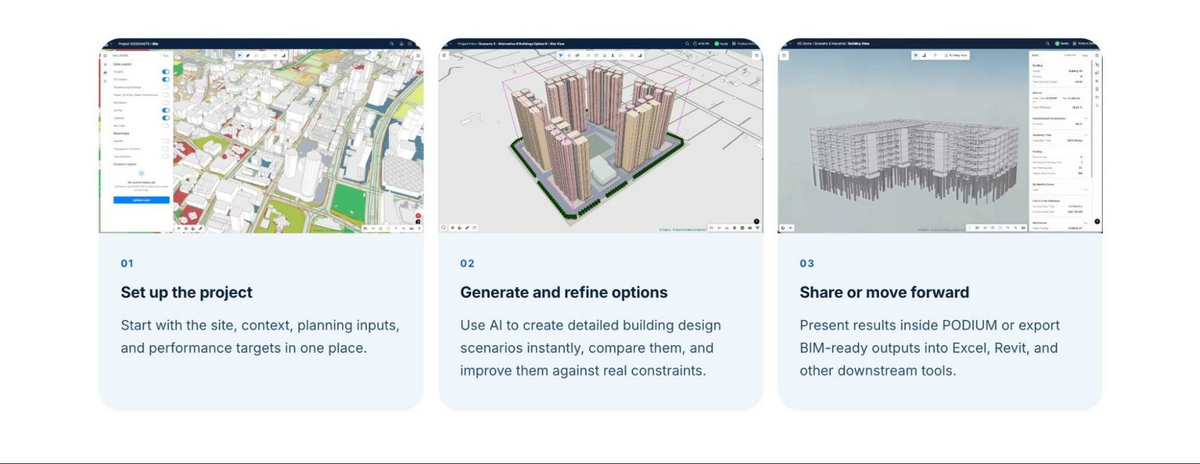
QS: We are not replacing BIM. Podium sits before BIM at the feasibility stage. Existing BIM tools require significant setup which takes time. Podium can generate a viable design with a data-rich model quickly. That output can then be taken into Revit for detailed design, so it becomes a complementary workflow. This removes the need for any complex BIM workflow setup.
BRJ: Developers often struggle to balance commercial metrics with design performance elements such as GFA efficiency, sustainability targets, and construction costs. How can AI help reconcile these competing priorities in real time?
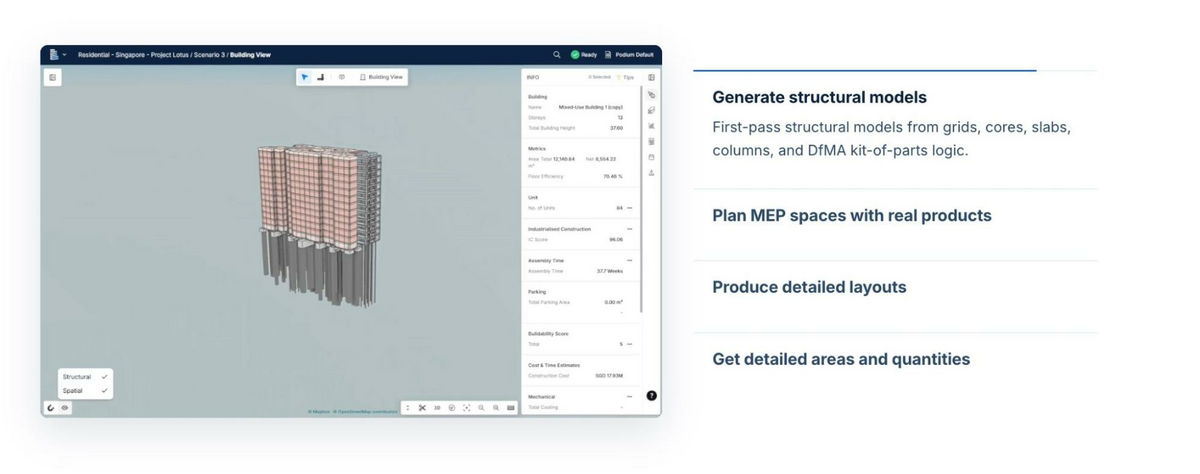
QS: It can help show the trade-offs visible in real time. Developers can see how changes impact GFA, cost, and efficiency instantly. We also generate early structural frameworks, which helps estimate key cost drivers. This allows teams to make informed decisions instead of relying on approximations.
BRJ: What kinds of projects are currently benefiting the most from AI-assisted feasibility and design?
QS: Data centres are growing very quickly, and developers cannot design or build fast enough to meet demand. Speed and accuracy at the early stage become critical, which is where AI adds immediate value.
Residential is also a strong use case across all segments, from social housing to luxury and mixed-use. The reason is scale and repetition. These projects involve many units, tight efficiency targets, and strong commercial constraints, so optimisation has a direct impact on returns.
BRJ: AI adoption often raises concerns about transparency and trust in automated decisions. How do you ensure that AI-generated design options remain engineer auditable and credible for developers and regulators?
QS: Our approach is not a black box. All inputs, rules, and assumptions are visible and traceable. The system is deterministic, so users can understand how a solution is generated. Ultimately, the human remains in control, with AI supporting faster and more accurate decision-making.
BRJ: Looking ahead 10 years, do you see AI primarily augmenting architects and planners, or fundamentally redefining who leads the early stages of urban development?
QS: Real estate development is inherently complex and requires coordination across many stakeholders, but today, the early stage is undervalued. In many Southeast Asian markets, feasibility work is often pushed to architects as free work in hopes of winning the project, which leads to slow, low-quality outputs and reduces their role to basic space planning.
AI tools and platforms change this dynamic. Feasibility can now be done much more accurately, quickly, and with clear measurable value. Because of that, it is no longer treated as free work, but as a capability worth investing in. This will drive developers to invest more in in-house teams equipped with such tools to own early-stage decisions.
Architects will shift away from offering free work towards higher-value services like design quality, identity, and placemaking. Overall, the industry moves towards value-based work, where differentiation comes from design and strategy, not just efficiency.
About Quentin Sim

Quentin Sim is the Chief Solutions Officer at PODIUM.io, working at the intersection of technology and the built environment. He works with global clients to define technical requirements, providing pre-sales leadership and translating client needs into product strategy and roadmap.
As a Singapore-registered architect with over a decade of experience in the built environment, Quentin applies his architectural, entrepreneurial, and academic experience to bridge industry realities with product strategy, ensuring Podium’s solutions are clearly positioned, deeply relevant to real project workflows, and effectively adopted by architects, developers, and project teams to drive measurable outcomes.
He brings deep industry expertise to his leadership role. Prior to joining Podium, he practiced architecture across diverse typologies, including residential, commercial, and hospitality projects throughout Asia and Europe. He has successfully led several high-profile, award-winning projects, such as Pan Pacific Orchard and the Singapore Pavilion at World Expo 2020 Dubai, the latter of which received the President’s Design Award 2023 — Singapore’s highest design accolade.
A staunch advocate for digital transformation, Quentin teaches as a Studio Tutor in Digital Design at the National University of Singapore (NUS), championing generative AI and digital innovation. He is also actively involved in industry initiatives, including serving as a co-lead for the annual SIA YAL Architect’s AI Hackathon over the past three years. Quentin holds a Master of Architecture from the National University of Singapore and studied at the École Spéciale d’Architecture in Paris.