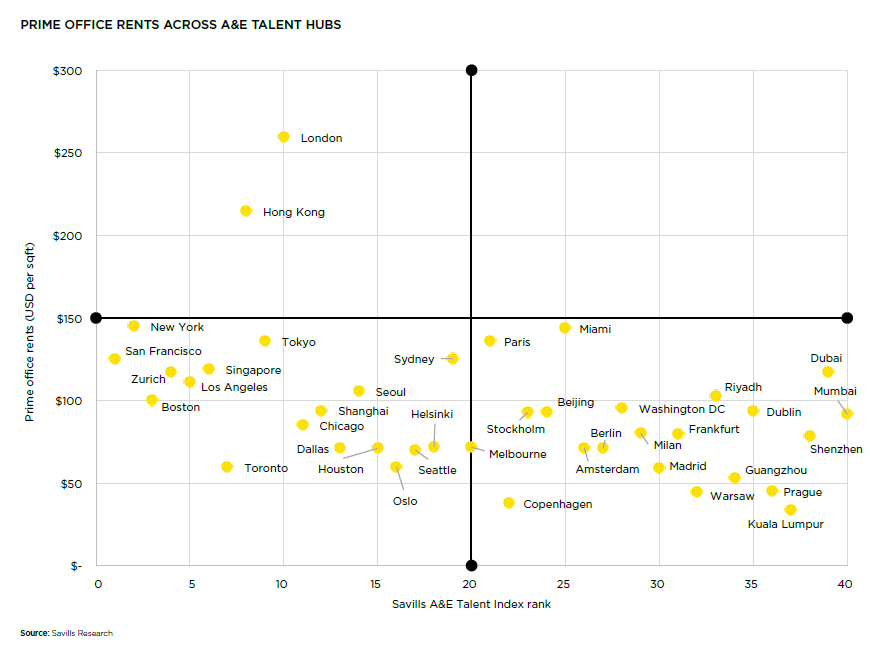
Singapore is ranked 6th globally in Savills’ Architecture and Engineering (A&E) Talent Index, reflecting the strength of its education base, established industry ecosystem and regional connectivity. However, its relatively higher operating costs reinforce the need for more strategic workplace planning among occupiers.
Currently, San Francisco and New York remain the dominant A&E talent hubs in North America, with Zurich and London leading in Europe. In Asia Pacific, Singapore is the highest-ranked location alongside major regional hubs such as Hong Kong and Tokyo. While Singapore benefits from a strong education base and mature industry ecosystem, its higher cost of living remains an important consideration in attracting and retaining skilled talent.
A survey of Savills experts around the world who work with A&E firms notes that 78 percent of respondents identify access to talent as the most important factor shaping portfolio decisions, followed by real estate costs at 74 percent and the cost of talent at 61 percent. This may lead to firms reassessing their location strategies to secure access to high-quality expertise in the face of talent shortages, while also seeking the best office spaces to showcase their technical capabilities and design philosophies at a lower cost.

However, some alternatives such as Dallas and Seattle in North America, Oslo and Helsinki in Europe and Melbourne in Asia Pacific are increasingly offering high-quality talent at lower office occupancy costs and may see increased demand from the sector. Singapore’s comparatively higher occupancy costs underscore the need for more strategic workplace planning as firms balance talent access with operational efficiency.
Ashley Swan, Executive Director, Commercial & Industrial, Savills Singapore, says: “As global uncertainties increase, Singapore’s stability, ease of operating and strong talent base continue to make it an attractive location for architecture and engineering firms. However, rising occupancy and operating costs mean companies need to be more deliberate in how they plan and use their office space. We are seeing occupiers place greater emphasis on workplace efficiency, flexibility and location to ensure they can attract and retain talent while managing costs effectively.”
Savills also examined the portfolio strategies of A&E firms in H2 2025: 64 percent of respondents said firms were maintaining or growing office space footprints (25 percent expanding, 39 percent maintaining) while 35 percent were planning on consolidating. There are regional differences: around 36 percent of firms in the US increased their office footprint, compared with 33 percent in EMEA and 15 percent in Asia Pacific. These findings reflect the broader factors influencing corporate real estate decisions in the sector, including access to talent, real estate costs and salary competitiveness.
Salary competitiveness varies across disciplines and markets. In Asia Pacific, cities such as Singapore and Tokyo rank among the region’s leading architecture and engineering talent hubs while maintaining globally competitive junior salary levels. Zurich and San Francisco rank highest in terms of average base pay for engineering and architecture talent respectively. This highlights how firms balance access to skilled talent with overall cost considerations when shaping their real estate strategies.
Sarah Brooks, Associate Director in Savills World Research team, comments: “For architecture and engineering firms, finding skilled talent is critical – but the cost of employing that talent and then accommodating it in suitable office space can vary widely globally. While the established A&E hubs are likely to always retain their attractiveness as places for firms, given their access to world-class universities and innovation, and accessibility to clients, our research identifies where perhaps more cost-conscious practices can access strong talent pools without the premium of the big global cities.”
Rick Schuham, CEO of Global Occupier Services at Savills, adds: “A combination of talent constraints, cost pressures, client expectations and tech are influencing where firms locate and how they configure their portfolios. Increasingly A&E firms are looking for their offices to demonstrate environmental leadership – and to provide tangible examples of flexible future-focused workplace practices to clients. Showcasing how technology can be integrated to help enable evolving work practices is also key. The competition, and therefore the occupier costs, for space that meets these requirements in the top global cities is fierce. Looking ahead, these location and cost pressures are set to intensify, giving informed corporate real estate planning an increasingly important role in supporting business performance.”