
A new report published by global programme manager, Turner & Townsend, reveals that the growth of AI infrastructure, including soaring demand for data centres, is squeezing global construction market capacity, including in Asia, adding to skilled labour shortages. This will drive rapid job creation and the introduction of innovative new construction approaches over the coming years. The construction market in Asia is poised for another phase of rapid economic development with booming investment in data centres, and surging advanced manufacturing and logistics sectors – 16 of 29 Asia markets reported “hot” or “overheating” market activity.
Now in its 17th year, Turner & Townsend’s Global Construction Market Intelligence report represents the definitive analysis of the global construction industry, with data gathered from 112 markets across 44 countries.
Key findings from the report include:
- Unlike most other global markets, residential and social housing remains the best performing sector in Asia, followed by data centres, industrial and logistics and office fit-outs
- Tokyo is the most expensive construction market in Asia ($5801.2 per square metre), and seventh globally, on the back of its blossoming data centre sector
- Osaka is the next most expensive ($5539.6 per square metre), followed by Sapporo ($5476.9 per square metre), and Fukuoka ($5293.8 per square metre), with five Japanese markets in the top 15 globally
- Fukuoka, Hiroshima, Penang, Johor Bahru, Kuala Lumpur, Osaka, Singapore and Tokyo to all see inflation rise by 2 percent or more 2025 vs 2026
- Mumbai to see inflation rise from 5 percent in 2025 to 15 percent in 2027 driven by booming demand for transport infrastructure and commercial space
- Hiroshima to face the highest cost inflation in Asia in 2026 at 6.2 percent, with New Delhi, Chennai, Fukuoka, and Tokyo all at 6 percent
- 90 percent of Asian markets say skilled labour shortages are having either a large or major impact on construction delivery
Across the world, the inexorable growth of AI has ensured data centres remain the most in-demand construction sector globally. Industrial & logistics ranks in second place, driven by supply chain reconfiguration as businesses increasingly invest in automation, turn to nearshoring strategies and respond to the rise of ecommerce. The pace of growth in AI in Asia has resulted in data centres becoming the most constrained sector in the region when it comes to contractor capacity, with nearly 70 percent of the markets in Asia reporting tightening or severe capacity constraints.
This growth is raising the likelihood of a severe shortfall in the skilled labour required to build data centres, and further fuels calls for increased training and more concentrated efforts to recruit the workforce needed to keep up with demand. On top of that, despite the volatility created by recent geopolitical events, construction input costs have stabilised over the past year, and as a result, labour availability is now the primary driver of cost escalation across the global construction market. 90 percent of Asian markets say skilled labour shortages are having either a large or major impact on construction delivery, and this is particularly the case in the specialist mechanical, electrical and plumbing (MEP) trades. 82 percent of markets in Asia report MEP trade shortages, which are essential in tech-centred projects.
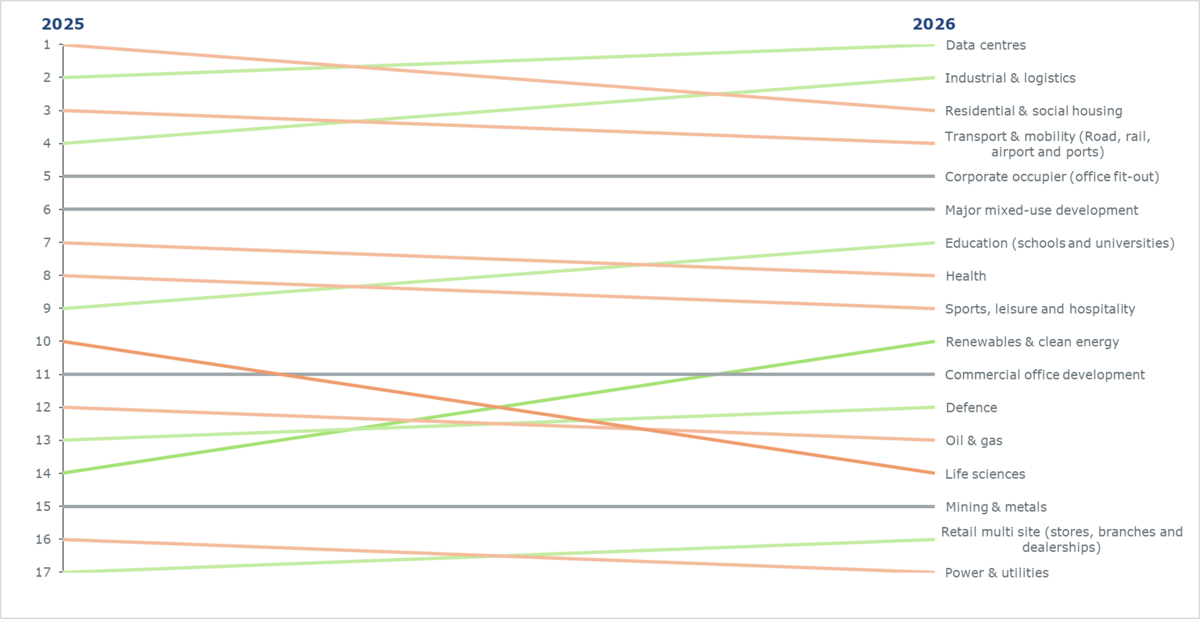
More broadly, geopolitical uncertainty is creating opportunities for other sectors, with nearshoring in particular driving growth in manufacturing-led construction, and industrial and logistics more generally. Similarly, unlike in other markets, office building and fit outs are seeing an uptick in activity, particularly in emerging markets like Manila and Hanoi, with the former strengthening its position as an offshore hub for services like call centres and human resources.
India continues to stand out for breadth of demand, with infrastructure, commercial occupier activity and a strengthening residential market all contributing to momentum, particularly in major urban centres. In Mumbai for example, there is set to be an inflationary jump from 5 percent this year to 15 percent in 2027, as booming demand for more transport infrastructure and commercial space is accelerating demand for land, materials and labour.
Sumit Mukherjee, Managing Director for Real Estate for Asia at Turner & Townsend, said: “The global construction market is shifting and new dynamics are reshaping the key drivers of cost performance. Demand is increasingly uneven and concentrated on AI-driven sectors like data centres, while broader labour constraints, supply chain volatility and geopolitical risk are becoming more pronounced.
“There is a very real risk that growth in the pool of skilled labour needed to build data centres won’t keep up with demand, particularly in Asia where the market for these types of assets is booming. In construction, AI has the potential to be a force for good in terms of job creation, but only if the right resources are put in place to support it.
“Across Asia, the construction market is poised for another phase of significant growth, with data centres and industrial and logistics leading the charge. In that context, there will be significant inflationary pressures, particularly around labour.
“Clients with global portfolios must use this opportunity to review international programmes to ensure the right projects are prioritised depending on local conditions. It is not only a question of the relative cost, but also factors such as interest rates, labour availability and digital maturity in the supply chain.”